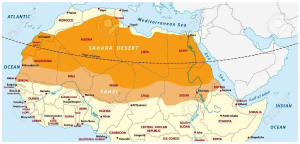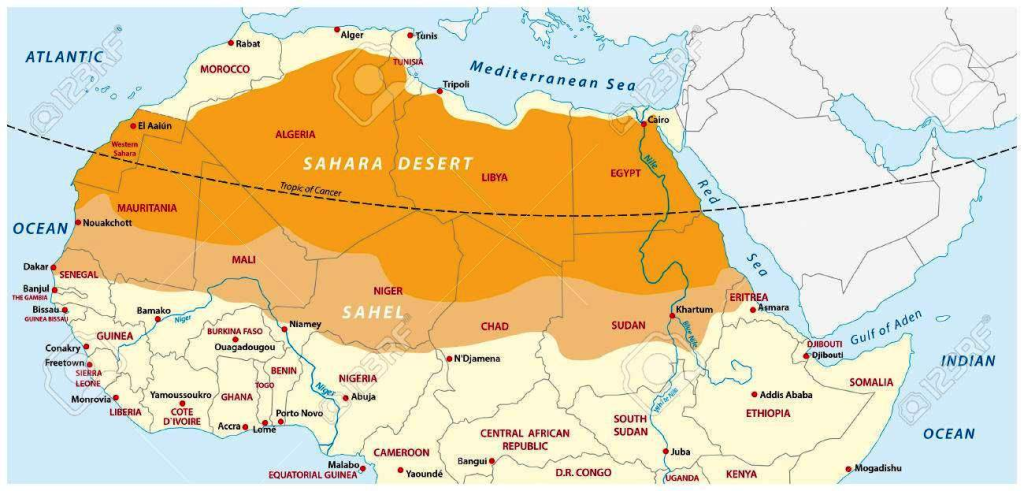
The Sahara Desert’s expansion is not a distant or abstract phenomenon—it is the visible unraveling of ecosystems. As the desert grows, fertile soils vanish, vegetation disappears, and the intricate web of life that depends on balance is broken. This is not simply a human inconvenience; it is a direct assault on biodiversity. Transitional zones that once supported diverse species are being erased, their habitats consumed by sand and heat. The desert’s advance is a threat to the continuity of life itself, undermining the resilience of the planet’s ecological systems.
🔎 Why the Expansion Occurs
The causes are clear and undeniable:
- Climate change intensifies droughts and shifts rainfall patterns, leaving landscapes parched and unable to regenerate.
- Deforestation and overgrazing strip the land of protective vegetation, exposing soil to erosion and accelerating degradation.
- Unsustainable agriculture drains the land of nutrients, pushing ecosystems past their breaking point.
- Feedback loops ensure that once vegetation is lost, the soil loses its ability to retain moisture, hastening desertification.
This is not a natural cycle—it is ecological breakdown caused by human exploitation. The Sahara’s expansion is the direct result of unsustainable practices that have ignored the limits of nature.
🌱 Rewilding as the Necessary Response
The only viable path forward is rewilding—restoring ecosystems at scale to resist the desert’s advance. Rewilding is not a luxury; it is the essential counterforce to collapse.
Rewilding requires:
- Restoring native vegetation that can withstand drought and stabilize soils.
- Reintroducing keystone species to regenerate ecosystems and maintain balance.
- Ending destructive land use practices that strip the earth bare.
- Allowing landscapes to recover through protection, not exploitation.
The Great Green Wall initiative is a beginning, but it must be expanded and intensified. Without rewilding, the Sahara will continue its march unchecked, consuming ecosystems that once supported life.
✅ Plausibility of Rewilding
Rewilding is entirely possible. Evidence from Senegal, Niger, and Ethiopia shows that degraded land can be restored, biodiversity can return, and soils can recover. These successes prove that ecosystems are resilient when given the chance. The barrier is not ecological feasibility—it is the refusal to prioritize ecosystems over short-term human demands.
🌟 Best-Case Scenario
Rewilding succeeds. The Sahara’s expansion halts. Grasslands and forests return, biodiversity flourishes, and ecosystems regain resilience. The Sahel becomes a living example of ecological renewal, proving that collapse can be reversed. The desert’s edge stabilizes, and life systems recover their strength.
⚠️ Worst-Case Scenario
Rewilding is ignored. The Sahara continues to expand. Habitats vanish, species are extinguished, and ecosystems collapse entirely. The desert becomes a graveyard of life, a monument to human negligence, and a warning of what unchecked exploitation brings. The disappearance of biodiversity cascades outward, destabilizing global ecological systems.
📝 Conclusion
The Sahara’s expansion is ecological collapse in motion. It is happening because of climate change and destructive land use. It can be stopped, but only through rewilding—restoring ecosystems at scale and allowing nature to recover. The choice is stark: renewal or extinction. The desert is advancing, and only rewilding can hold the line.
This is not a matter of human convenience—it is a matter of planetary survival. The Sahara’s expansion is a threat to life systems themselves, and the only response equal to the crisis is rewilding.